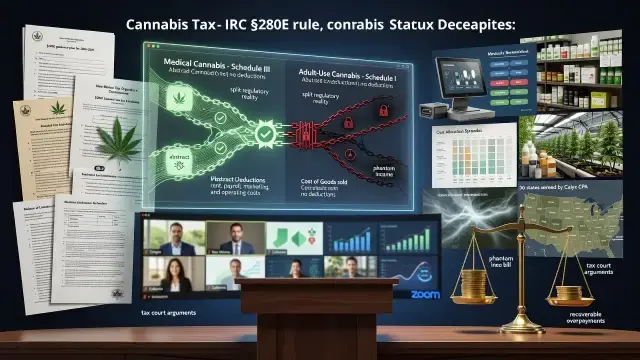
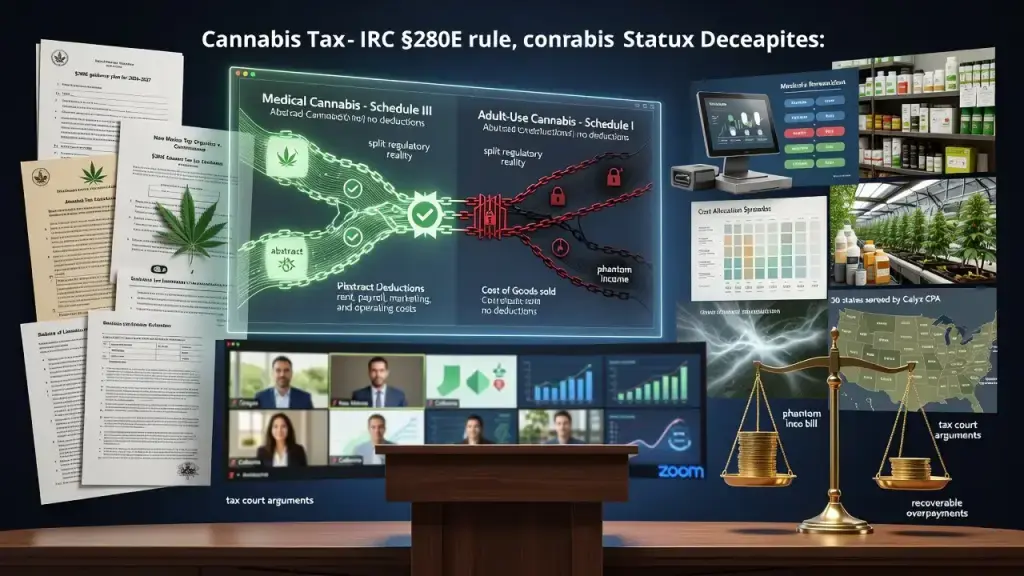
Calyx CPA will host a free webinar on Monday, Nov. 9, breaking down a tax problem that has quietly become one of the thornier compliance puzzles in the industry: what happens to federal tax treatment when medical cannabis sits on Schedule III while adult-use product stays locked into Schedule I. The session, led by CEO Justin Botillier, runs at 10 a.m. PST / 1 p.m. EST over Zoom and is open to operators trying to make sense of a tax code that hasn't caught up to a split regulatory reality.
Here's the catch for multi-license operators: a business selling into both medical and adult-use channels can no longer assume one tax posture applies across the board. Medical-only operations may now claim deductions long denied under IRC §280E, the provision barring standard business expense deductions for companies trafficking in Schedule I or II substances. Adult-use revenue, though, remains fully exposed to §280E's harsher math - no deductions for rent, payroll, marketing, or most operating costs beyond cost of goods sold. For mixed-use operators, that means parsing revenue streams, allocating costs, and in some cases running what amounts to two separate tax profiles under one roof.
Why the Guidance Gap Matters to Operators
The IRS has added §280E guidance to its 2026-2027 Priority Guidance Plan, which sounds like progress. In practice, though, the plan sets no release deadline, leaving dispensaries, cultivators, and multi-state operators to make current filing decisions without a clear federal roadmap. That's not a small gap. Tax bills under §280E have historically run far higher than what comparable non-cannabis retailers owe, since the inability to deduct ordinary expenses inflates taxable income well beyond actual profit. Businesses budgeting for 2026 filings are effectively planning around an open question.
The Fight Over Prior-Year Taxes
The webinar will also dig into litigation that could matter more, in dollar terms, than any forward-looking guidance. New Mexico Top Organics v. Commissioner is testing whether §280E should ever have applied as broadly as the IRS has enforced it - specifically, whether the statute's reach extends only to substances formally listed on Schedule I or II, or whether it also covers substances falling "within the meaning of" those schedules. That distinction isn't academic. If courts side with the narrower reading, and if federal findings on cannabis's medical and scientific status carry legal weight in that argument, operators who paid years of inflated tax bills on what amounts to phantom income may have grounds to claim it back.
Botillier is expected to address the mechanics of that potential recovery, including:
- Amended returns and the timing constraints around filing them
- Refund claims tied to prior-year §280E overpayments
- Protective claims that preserve a business's right to refunds while litigation remains unresolved
- Statutes of limitation that could close the window on recovery if operators wait too long
What's at Stake for Mixed-Use and Multi-State Operators
None of this is abstract for businesses running compliant operations across state lines. A dispensary group with both medical and adult-use licenses needs accounting systems - and advisors - capable of tracking which revenue falls under which tax treatment, a task that touches everything from point-of-sale categorization to how cost allocations get documented for audit purposes. Get it wrong, and the exposure isn't limited to back taxes; it includes penalties and interest on top. Get it right, and some operators may be sitting on recoverable overpayments from years when §280E's reach was broader, at least in theory, than it may ultimately prove to be in court.
Calyx CPA works with operators across more than 30 states, ranging from single-location dispensaries to vertically integrated multi-state operations, along with Oregon's emerging psilocybin service centers. The firm's focus on this particular tax fight reflects a broader truth about cannabis business today: the regulatory status of the plant itself is only half the story. The other half is being argued, quietly, in tax court.