
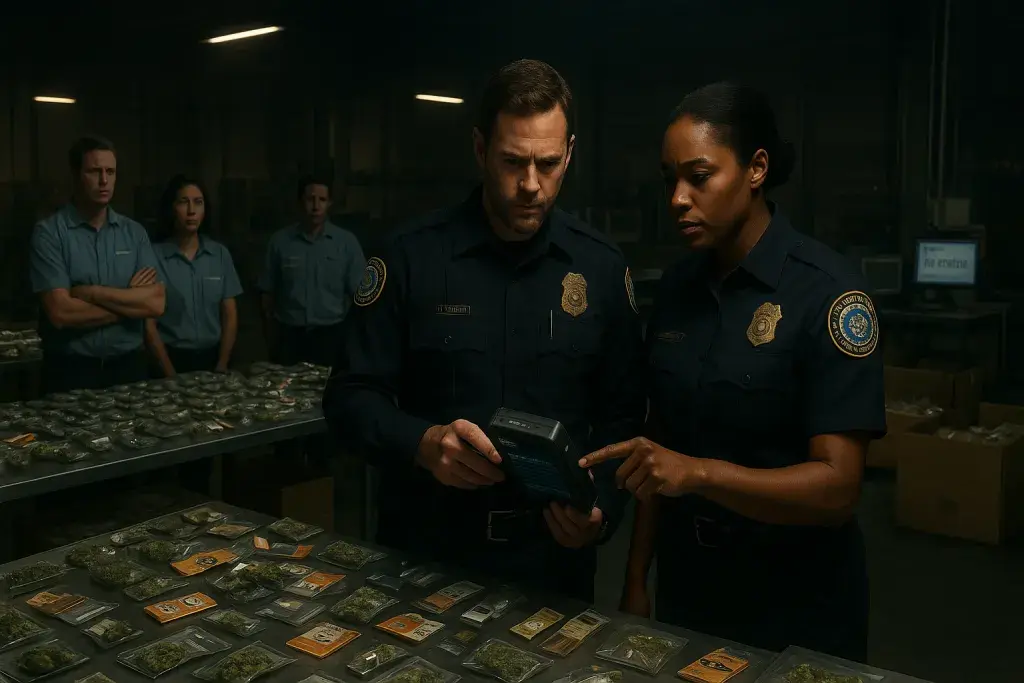
The Michigan Cannabis Regulatory Agency has filed a formal complaint against VJAS 1, a licensed cannabis processor based in Harrison Township, after an inspection revealed more than 12,000 individual cannabis products with no Metrc tags or other identifying information - including products in California-specific packaging. The enforcement action puts the facility's license at immediate risk, with potential penalties ranging from fines to outright revocation. For the broader Michigan cannabis industry, it's a sharp reminder of what seed-to-sale tracking is actually designed to prevent.
What makes this case notable isn't just the scale. Investigators found products in packaging bearing the letters "CA" and California-mandated consumer warning language - which points well beyond a simple inventory management lapse. Seed-to-sale traceability systems like Metrc exist precisely because regulators need to know where every unit of product originated, who handled it, and where it currently sits in the supply chain. The moment a product enters a licensed facility without a tag, it falls outside that verified chain entirely - and the legal, public safety, and compliance exposure is immediate. Operators in other regulated markets running modern pos cannabis new york infrastructure understand that real-time inventory reconciliation isn't optional; discrepancies between physical stock and system records are the first thing compliance auditors look for, and gaps of any size draw scrutiny. Here, the gap wasn't a handful of SKUs - it was more than 12,000 units.
Compounding the problem: investigators found products at the VJAS 1 facility that did carry valid Metrc tags - but cross-referencing those tags against system records showed the products were supposed to be located at entirely different cannabis businesses. That's a separate and serious category of violation. It suggests either that tagged inventory was physically moved between licensed facilities without proper transfer documentation, or that tags were applied to products in ways that don't reflect actual chain-of-custody. Either way, the integrity of the tracking record itself is in question, and that's exactly the scenario Metrc-based compliance is built to prevent.
What Seed-to-Sale Tracking Is Actually Built to Catch
Metrc - Michigan's mandatory cannabis track-and-trace platform - assigns unique radio-frequency identification tags to plant material and harvested product at the point of origin. Every transfer, every wholesale transaction, every retail sale is supposed to generate a corresponding record in the system. The tag doesn't just identify a product; it tells regulators where that product has been and who is legally responsible for it at every stage. When products arrive at a facility without tags, there is no record to consult. Employees at VJAS 1, according to the CRA, were unable to explain the origin of the untagged inventory - which is itself a compliance failure, separate from whatever the actual source of the products may have been.
The presence of California-packaged product in a Michigan-licensed facility raises questions that go beyond paperwork. Michigan's adult-use and medical cannabis market operates as a closed system - licensed cultivators, processors, and retailers are required to source product from other licensed Michigan operators and document every transaction through Metrc. Product manufactured for and sold in a different state's regulated market has no legal pathway into a Michigan licensed facility's inventory. California cannabis labeling and packaging requirements are state-specific; product bearing that designation isn't compliant for Michigan retail or wholesale, and it shouldn't exist anywhere in a Michigan licensee's physical space.
License Exposure and What Comes Next
VJAS 1 now faces a formal administrative complaint process. The CRA's enforcement toolkit includes fines, license suspension, restriction, and revocation - as well as refusal to renew. Michigan, like most regulated cannabis states, structures its licensing penalties on a tiered basis, with the severity of the action tied to the nature and extent of the violation. A complaint of this scope - thousands of untagged products, out-of-state packaging, and inventory tag mismatches across facilities - sits at the serious end of that spectrum. The processor has the right to contest the charges through the state's administrative hearing process, but the evidentiary record from the inspection is substantial.
For other Michigan processors and, frankly, operators across every state-licensed market: this is the operational risk that builds quietly. Inventory systems drift. Products get moved informally between locations. Tags get separated from product during processing. None of those things are acceptable in a licensed facility, and regulators audit specifically to find them. Maintaining tight Metrc compliance isn't a formality - it's the only thing that separates a licensee's inventory from contraband in the eyes of the law. When employees can't account for the origin of products sitting in their own facility, that's not an inventory problem. That's a licensing problem.