New York City's adult-use cannabis market has expanded faster than most regulated markets anticipated - hundreds of licensed dispensaries now operate across all five boroughs, and the Office of Cannabis Management lists more than 670 adult-use licensees statewide. But the gray market didn't disappear when the legal one arrived. Unlicensed shops remain a visible presence on commercial corridors, and for tourists, residents, and the licensed operators competing against them, that split market creates real consequences: safety risks, consumer confusion, and persistent downward pressure on legal sales.
The operational gap between a licensed dispensary and an unlicensed storefront is not cosmetic. A licensed retailer in New York carries seed-to-sale traceability obligations, compliant packaging with the state's universal symbol, a Certificate of Analysis link on every product, and age-verification requirements enforced at point of sale. Other regulated markets have built similar compliance architectures - in Alaska, for instance, dispensaries managing multi-SKU inventory use tools like cannabis pos alaska point-of-sale systems to stay aligned with state tracking mandates. New York's licensed operators face comparable demands, and that compliance infrastructure is precisely what unlicensed shops skip. No mandatory lab testing. No regulated manufacturing oversight. No consumer protection if something goes wrong.
Here's the catch for anyone buying in NYC: the storefront doesn't advertise its legal status on the sidewalk. That's why the OCM's blue-and-white Dispensary Verification Tool sticker - posted near the main entrance, scannable via QR code - matters operationally, not just symbolically. If the sticker isn't there, cross-check the shop against OCM's official locator before purchasing anything. Licensed product packaging will carry the New York universal symbol, accurate potency disclosures, and a working COA link. Unlicensed product won't reliably offer any of those things, and city health officials have warned that untested cannabis products may contain harmful or inaccurate ingredients.
What Enforcement Has Actually Moved - and What It Hasn't
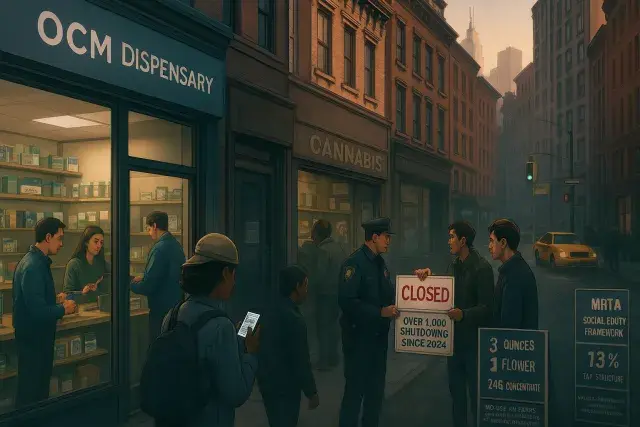
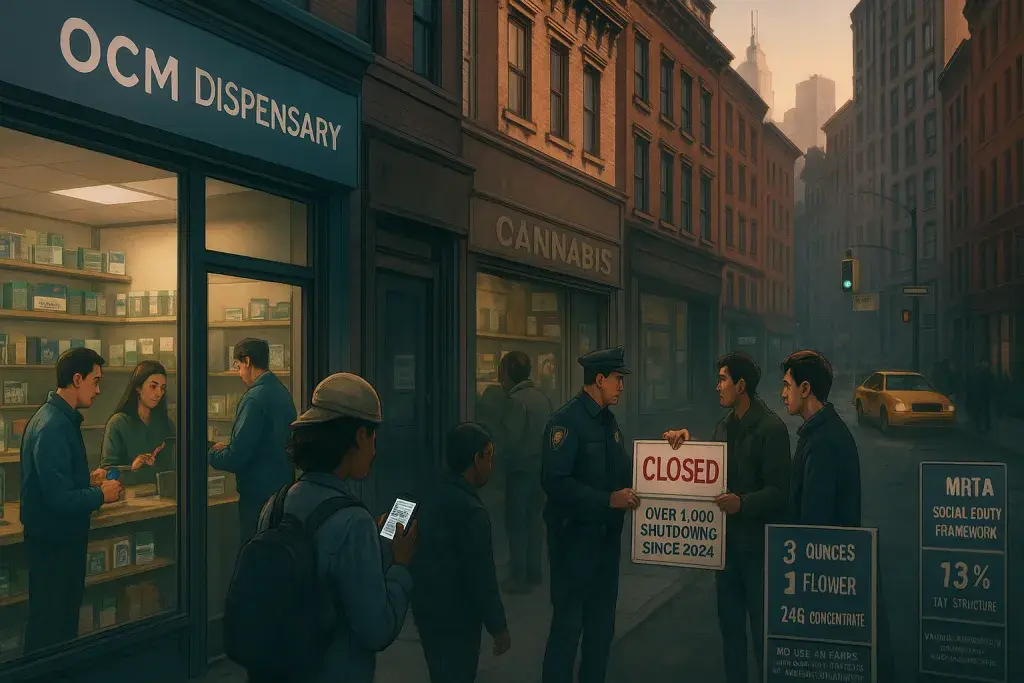
New York and New York City have shut down more than 1,000 illegal cannabis shops, with NYC reporting nearly 1,400 closures since May 2024 as of a 2025 update. That's aggressive enforcement by any comparable state's standard. And there's a measurable market signal embedded in that data: legal sales reportedly rose following enforcement surges, which tells you something about consumer behavior. When legal options are visible and easy to verify, buyers default to them. The problem is that illegal operators have shown a capacity to reopen or relocate, which means enforcement alone doesn't resolve the structural imbalance - it has to be paired with legal market density and accessibility.
For licensed operators, this matters beyond competitive fairness. Every unlicensed shop that absorbs tourist foot traffic represents lost revenue that could otherwise support the social equity framework baked into the Marijuana Regulation and Taxation Act. The MRTA explicitly prioritized licensing for individuals affected by past cannabis prohibition. When the gray market captures sales that should flow to those operators, it undermines the policy intent, not just the economics. That's a business and regulatory problem simultaneously.
Possession Rules, Tax Structure, and What Tourists Actually Need to Know
Adults 21 and over can purchase recreational cannabis in NYC without New York residency - a valid government-issued photo ID suffices. Possession limits outside the home are 3 ounces of cannabis flower and 24 grams of concentrate, which covers oils, vapes, tinctures, and edibles. Retail cannabis sales carry a 13% total tax burden - 9% state, 4% local - and adult-use products are exempt from standard sales tax. Pricing at licensed dispensaries generally runs $28 to $75 per eighth for flower depending on tier, $25 to $50 for a 100mg edible package, and $35 and up for vape cartridges.
Consumption restrictions are specific and worth treating seriously. Cannabis use is prohibited in NYC parks, on beaches, in vehicles, on school grounds, inside restaurants and bars, and on all federal property - which includes every airport in the metro area. Most hotels prohibit it under their own policies. Tourists should also be clear that cannabis cannot legally cross state lines or travel on any commercial flight; federal law applies regardless of origin or destination state. Carrying legal amounts on the subway is permissible; consuming on the subway is not.
The Compliance Floor That Separates Legal from Unlicensed
What a licensed New York dispensary offers isn't just a product - it's a documented chain of custody. Every item on a legal dispensary's shelves has passed through OCM's regulated supply chain: cultivation licensing, processor oversight, tested batches, compliant labeling. The budroom inventory at a licensed shop is traceable in a way that unlicensed product simply isn't. That's the compliance floor, and it exists to protect consumers in ways that storefront aesthetics or product branding cannot replicate.
For operators considering the New York market or investors watching its maturation, the signal worth tracking isn't just the licensed dispensary count - it's how quickly the legal market captures share from the gray market as enforcement intensifies and licensed locations multiply across all five boroughs. The market is young. The framework is real. But the work of converting consumer habits from unregulated to regulated retail is still very much in progress.