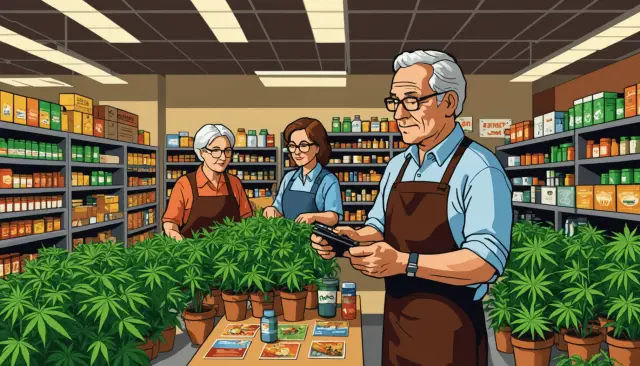
Michigan's cannabis industry has spent years treating oversupply as an unsolvable math problem: too many licensed grows, too much flower on wholesale menus, prices sinking toward unsustainable territory. But a demand-side story has been building quietly, and it doesn't involve a single new dispensary license. Baby Boomers - consumers now in their 60s, 70s and beyond - are consuming cannabis at rates that would have seemed implausible a decade ago, and the purchasing data suggests operators in Michigan and Ohio may be sitting on a customer segment they've barely tried to serve.
National survey data compiled through the Monitoring the Future project shows nearly 22 percent of Americans ages 55 to 65 consumed cannabis in the past year, the highest share that survey has ever recorded. Cannabis market data attributed to Headset puts Baby Boomer spending at roughly 12.6 percent of tracked U.S. sales - smaller than Millennials or Generation X, but far from negligible when applied against a market the size of Michigan's or Ohio's. Applied against Michigan's 2025 sales figures, that share implies an older-adult market approaching $400 million annually; add Ohio's recreational sales and the combined figure edges toward half a billion dollars. Those are estimates, not state-reported breakdowns - Michigan's Cannabis Regulatory Agency doesn't publish sales by generation - but they point toward a segment operators haven't systematically pursued. For multi-state operators managing inventory across both markets, the calculus starts with better visibility into who's actually buying; platforms like Illinois seed-to-sale dispensary software illustrate how compliance-grade tracking tools, originally built for METRC reporting and batch traceability, are increasingly being adapted by retailers to understand purchasing patterns across age cohorts, not just product categories.
Why Older Buyers Don't Shop Like Everyone Else
Here's the catch: selling to Boomers isn't the same business as selling to twenty-somethings buying high-potency flower. University of Michigan polling on healthy aging found that among cannabis consumers 50 and older, the dominant motivations were relaxation, sleep support and pain management - not intensity of effect. That points toward a different SKU mix entirely: lower-dose edibles, tinctures, topicals, and balanced THC-CBD formulations rather than the high-potency concentrates driving much of the current wholesale price war. Dispensaries built around fast-moving, high-THC inventory may need a distinct budroom section, staff trained differently, and packaging language that speaks to a first-time-in-decades customer rather than an experienced daily consumer.
Service, Not Just SKUs, May Be the Differentiator
In a state where an ounce of flower has dropped below $60, competing on price alone is a losing proposition for most retailers. Service could be the more durable differentiator. Someone returning to cannabis after 30 or 40 years faces a dispensary environment unrecognizable from what they remember - vape cartridges, live resin, nano-emulsified beverages, dozens of ratios of THC to CBD. That complexity creates real friction, and it means budtender training and point-of-sale education become part of the sales process, not an afterthought. Retailers that build genuine consultative service - walking a new-to-modern-cannabis customer through dosing, format and onset time - may capture loyalty that a discount code never will.
The Compliance and Safety Line Operators Can't Ignore
None of this comes without risk. Today's cannabis products carry considerably higher THC concentrations than what existed decades ago, and University of Michigan polling found 83 percent of older Michigan adults recognize that shift. Older consumers are also more likely to be on prescription medications, raising legitimate concern about interactions that dispensary staff are not licensed to advise on. Notably, more than a third of monthly cannabis users in that age group reported never having discussed their use with a health care provider, and a meaningful share admitted driving within two hours of consuming. That's a liability and public-safety conversation retailers can't sidestep - compliant labeling, dosage transparency and clear non-medical framing on packaging matter more, not less, as this customer base grows.
- Product mix shift: lower-dose edibles, tinctures and THC-CBD blends over high-potency flower
- Staff training: budtenders equipped to guide first-time-in-decades consumers through format and dosing
- Compliance exposure: no medical claims permitted on sleep, pain or mood-related marketing
- Data infrastructure: seed-to-sale and POS systems capable of surfacing demographic purchasing trends
Michigan's oversupply problem won't disappear because a new customer segment shows up. But the assumption that the state has already captured every willing buyer looks shakier than it did a year ago. For operators squeezed by a 24 percent wholesale tax and razor-thin margins, finding demand that doesn't yet exist on their shelves may matter more than finding another way to cut costs.