Pennsylvania Attorney General Dave Sunday has joined more than 30 counterparts nationwide urging Congress not to delay a federal redefinition of hemp set to take effect in three months. The change would close what law enforcement calls a loophole allowing intoxicating THC products to be sold largely unregulated at gas stations and convenience stores. For dispensary operators, hemp processors, and compliance teams across the state, the outcome will determine which product categories survive and which disappear from shelves entirely.
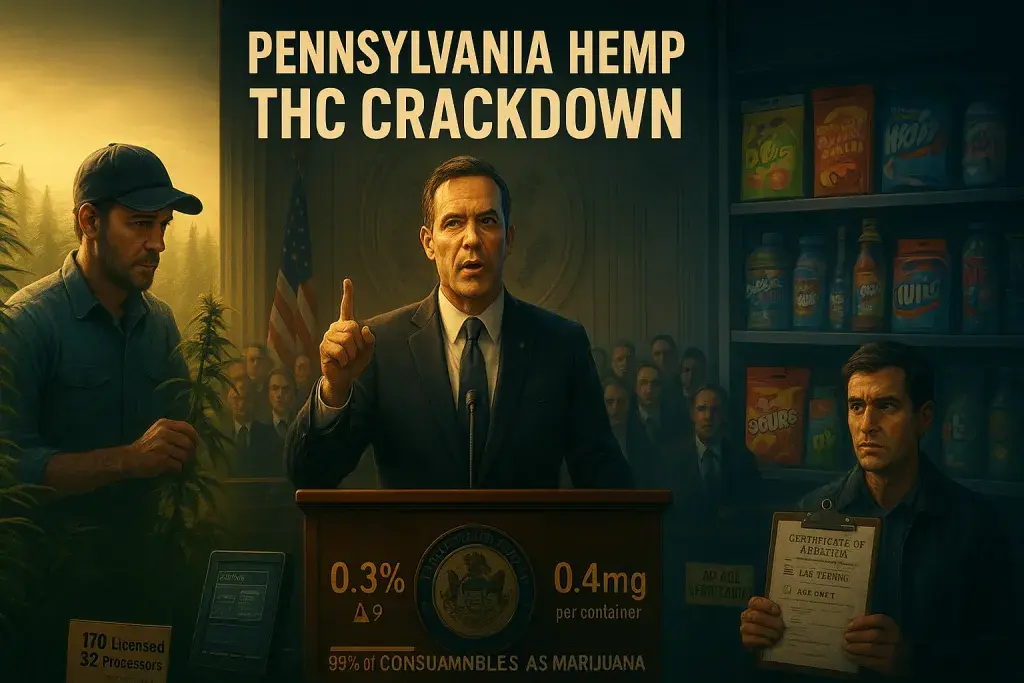
The stakes are not abstract. Pennsylvania's Department of Agriculture has licensed 170 hemp growers and 32 processors, roughly half of whom supply manufacturers making consumable goods like CBD drinks and gummies. That's a functioning supply chain built over seven years since the 2018 Farm Bill - one that now faces a hard reset. Operators who have invested in extraction equipment, lab testing partnerships, and retail distribution deals are watching a federal calendar they don't control. Retail infrastructure built for cannabis and hemp-adjacent products, including systems like a South Carolina dispensary POS platform designed to track inventory and compliance across shifting state rules, illustrates how much operational weight sits on regulatory definitions that can change overnight. South Carolina dispensary POS platform
Total THC Standard Changes the Math
Here's the mechanism at issue. Current federal law defines hemp by delta-9 THC content alone - under 0.3% at harvest. The new language measures total THC, folding in delta-8 and other cannabinoids, and caps finished products at 0.4 milligrams per container. That sounds like a technical tweak. In practice, it reclassifies a huge share of the existing consumable market as marijuana under federal law, regardless of intent or branding.
Industry group U.S. Hemp Roundtable estimates the change could eliminate roughly 95% of hemp consumables nationally - tinctures, gummies, drinks, and supplements that contain trace, non-intoxicating THC but would still fail the new container standard. Industrial hemp grown for fiber, grain, textiles, and biofuel is exempted, so farms supplying those markets are largely insulated. Farms and processors feeding the consumable pipeline are not.
Compliance Clarity Versus Business Survival
Law enforcement's argument is straightforward: ambiguity in the 2018 rules let unregulated, sometimes unlabeled intoxicating products reach convenience store shelves with no age verification, no consistent lab testing, and packaging that in some cases mimicked candy or soda brands aimed at kids. A uniform federal standard, attorneys general argue, gives police and prosecutors a clean line to enforce and prevents a patchwork of conflicting state rules from collapsing under legal challenges.
Hemp advocates don't dispute the consumer-safety problem - they dispute the remedy. Jake Sitler, who runs a Lancaster-based hemp beverage company and leads the Pennsylvania Hemp and Cannabis Guild, has pushed for regulation modeled on alcohol: published certificates of analysis, bans on synthetic cannabinoids, and enforced age restrictions at point of sale. His argument is one dispensary compliance officers will recognize immediately - a ban without a regulated alternative just pushes demand into an unregulated market with even less oversight.
What Operators Should Watch Next
The provision delaying implementation is currently attached to a federal stopgap funding bill in the Senate, with some lawmakers pushing to strip it out entirely. For Pennsylvania growers like Tyler Shannon, who sells hemp exclusively into the CBD supply chain rather than intoxicating product lines, the distinction Congress never drew in 2018 - raw plant THC versus finished product THC - is now the difference between staying in business and shutting down.
- Growers and processors selling into non-intoxicant markets face collateral damage despite compliant operations.
- Retailers carrying delta-8 and delta-10 products should prepare for a Nov. 12 compliance deadline absent congressional action.
- State-level statutes mirroring current federal hemp definitions will need rapid revision if the delay fails.
- Lab testing, COA transparency, and age-gated retail sales remain the core asks from industry groups seeking a regulated middle path.