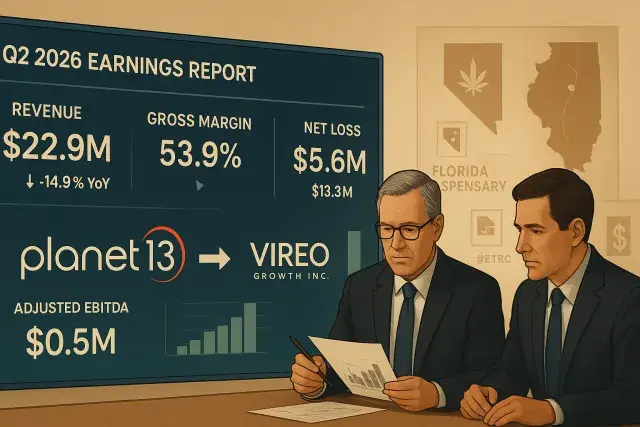
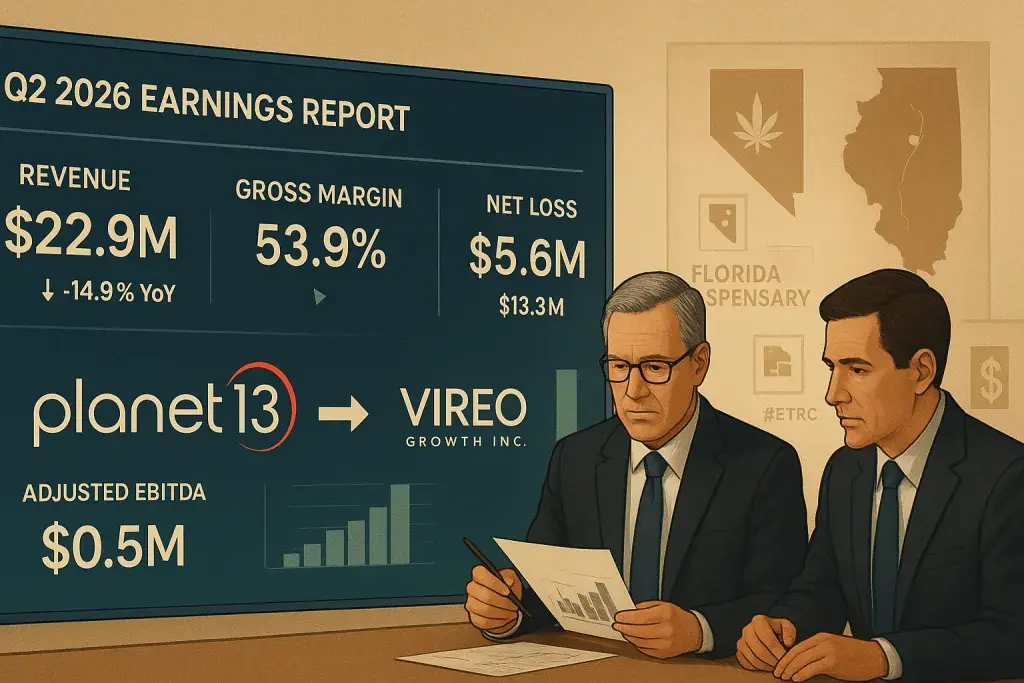
Planet 13 Holdings reported second-quarter 2026 results on Aug. 12 that showed a company narrowing its losses even as top-line revenue kept shrinking. Revenue fell 14.9% year over year to $22.9 million, but gross margin climbed to 53.9% and the net loss shrank to $5.6 million from $13.3 million a year earlier. The numbers land against the backdrop of a pending merger with Vireo Growth Inc., a deal that now shapes how investors and operators alike should read every line item.
Margin Gains Tell a Different Story Than Revenue Declines
Here's the catch with this quarter: the headline revenue drop looks worse than the underlying business performance. Planet 13 exited California retail and wholesale operations entirely, and that move alone explains a meaningful share of the year-over-year sales decline. Exiting an unprofitable state is not the same as losing market share in a state where you still compete. Once you strip out California, the remaining footprint in Nevada, Florida and Illinois told a more encouraging story, with gross margin improving through company-wide cost and procurement initiatives rather than through price increases the market likely wouldn't absorb anyway.
A $1.0 million reduction in the inventory reserve for Florida distillate also boosted the gross margin figure, a reminder that non-cash adjustments can flatter a quarter's optics. Excluding that adjustment, gross margin still came in at 49.5%, which is a credible number for a vertically integrated operator navigating continued price compression in two of its three core markets. Total expenses fell 17.7%, and Adjusted EBITDA loss narrowed to $0.5 million from $2.4 million. That's the kind of cost discipline operators in mature adult-use markets increasingly need just to stay upright.
Florida's Sequential Growth Matters More Than It Looks
Florida revenue rose 17.1% quarter over quarter, a detail Co-CEO Larry Scheffler flagged directly. In practice, though, sequential growth in a single state doesn't offset broader wholesale price compression across Nevada and Florida alike, both markets where an expanding number of licensed cultivators and processors keep pushing wholesale menus lower. Planet 13's OMMU approval for a Florida BHO extraction facility in May, along with the planned Sarasota store announced in July, point to a company still investing in Florida even as it retreats from California. That's a deliberate bet: consolidate where unit economics work, cut losses where they don't.
The Vireo Merger Reshapes What These Numbers Mean
What's striking here is how much the merger announcement changes the calculus for reading a standalone quarterly report. Planet 13 didn't hold its usual conference call this quarter, citing the pending transaction, a common practice once a definitive merger agreement is signed and companies enter a quiet period to avoid complicating disclosure obligations. Co-CEO Bob Groesbeck was candid about the rationale: the market rewards scale, purchasing power, distribution reach and balance-sheet strength to absorb price compression, and a combined entity with Vireo Growth is positioned to compete on those terms in ways a smaller standalone operator cannot.
For dispensary operators and wholesale suppliers watching multi-state consolidation, this deal fits a broader pattern in cannabis retail: mid-size operators facing 280E tax burdens, thin margins from state-level price compression and the capital intensity of vertical integration are increasingly looking to combine rather than compete alone. Balance sheet metrics reinforce the pressure - total liabilities rose to $105.5 million from $101.2 million even as total assets slipped to $144.3 million, a gap worth watching as the merger moves toward closing.
What Operators and Investors Should Watch Next
- Whether Florida's sequential revenue growth holds up as additional stores, including Sarasota, come online amid continued wholesale price pressure.
- How regulators review the Vireo Growth merger, including any state-level licensing transfer requirements across Nevada, Florida and Illinois.
- Whether the combined company's scale meaningfully improves purchasing power on cultivation inputs and compliant packaging, a persistent cost center for vertically integrated operators.
- How the market responds once shareholders vote on the transaction, given that Planet 13 stockholders will hold a stake in the merged entity rather than cash consideration.
None of this changes the basic consumer-facing obligations that apply regardless of corporate structure: age verification at the point of sale, compliant packaging, batch-level lab testing with certificates of analysis, and adherence to state seed-to-sale tracking through systems like METRC remain non-negotiable regardless of who owns the license. Consolidation changes ownership and balance sheets. It does not change the compliance floor every operator has to clear.