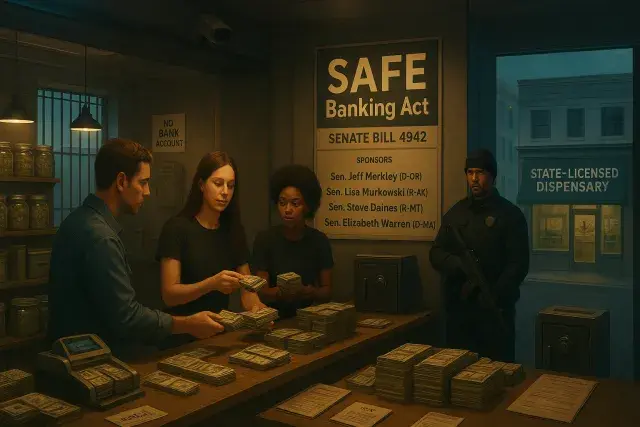
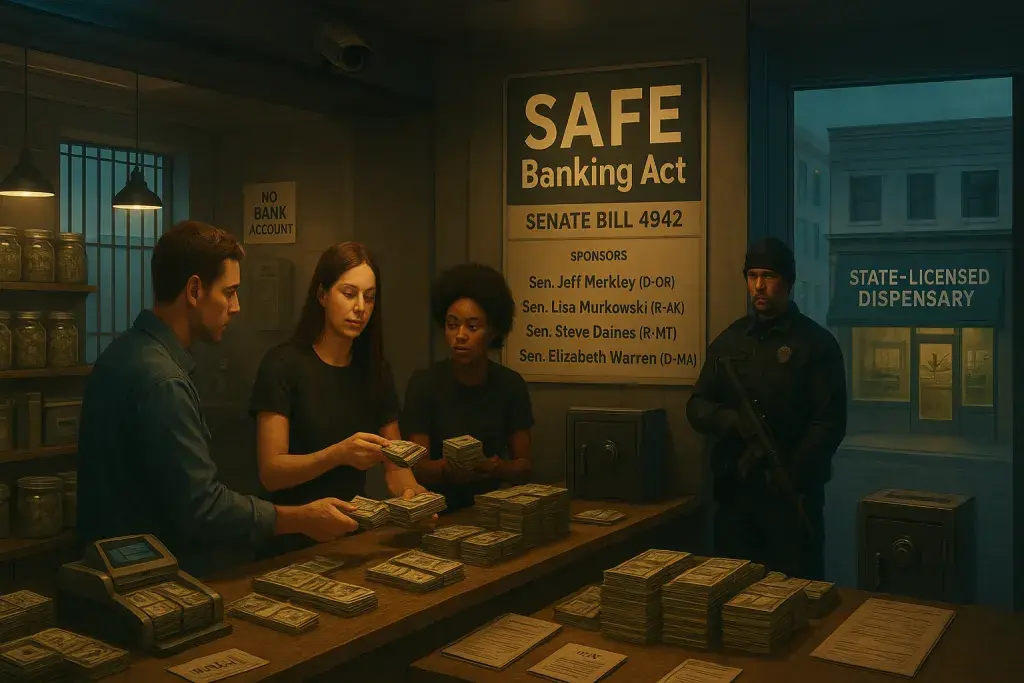
A bipartisan group of U.S. senators has reintroduced the SAFE Banking Act, renewing pressure on Congress to resolve one of the most operationally disruptive conditions facing licensed cannabis businesses: the near-total exclusion from traditional banking services. Senate Bill 4942, filed by Senator Jeff Merkley (D-OR) and cosponsored by Senators Lisa Murkowski (R-AK), Steve Daines (R-MT), and Elizabeth Warren (D-MA), would bar federal banking regulators from penalizing financial institutions solely for serving state-legal marijuana businesses. It does not legalize marijuana federally, and it does not require any state to permit cannabis sales.
For dispensary operators, the bill's return is not abstract policy news - it lands directly on the floor of every budroom in the country that is still running predominantly on cash. Point-of-sale systems can record every transaction down to the SKU, compliance logs can satisfy state regulators, and seed-to-sale tracking can account for every gram in inventory; but none of that sophistication fixes the fundamental problem of a licensed retailer that cannot open a business checking account without risking account closure. Operators managing multi-location retail, payroll, and wholesale purchasing in cash face compounding operational costs and security risks that a standard business simply does not encounter. For context on how state-level financial and compliance pressures affect everyday store operations, resources like this dispensary POS documentation for specific markets illustrate how tightly technology and regulatory compliance are already woven into retail workflows - even before the banking layer is resolved.
Why the Banking Gap Persists Despite Widespread State Legalization
The conflict is structural, not accidental. Marijuana remains a Schedule I controlled substance under the federal Controlled Substances Act. That classification creates legal exposure for any federally chartered or federally insured financial institution that knowingly processes funds tied to cannabis commerce - regardless of whether those transactions are fully compliant under state law. Banks and credit unions are not willing to absorb that risk without federal cover. The result is that a dispensary licensed and inspected by its state regulatory authority, paying excise taxes, filing seed-to-sale reports, and operating under strict compliant packaging requirements, still cannot reliably maintain a merchant account, process standard card payments, or access conventional business credit.
The SAFE Banking Act is designed to provide that federal cover. It would prohibit banking regulators - the FDIC, OCC, Federal Reserve, and NCUA, among others - from taking adverse action against an institution purely because it chose to serve a marijuana business operating in compliance with state law. Critically, the bill also extends protections to ancillary businesses: landlords leasing commercial space to dispensaries, accountants handling cannabis-industry tax work, attorneys advising licensed operators, and security firms protecting cash-heavy retail locations. All of these service providers currently absorb some version of the same risk, even though their business with the cannabis industry is entirely lawful under state law.
Rescheduling and SAFE Banking Are Not the Same Problem
The bill's reintroduction comes just days before a Drug Enforcement Administration administrative hearing, set to begin June 29, on the Trump administration's move to reschedule marijuana from Schedule I to Schedule III under the Controlled Substances Act. Those two tracks are related in public conversation, but supporters of the SAFE Banking Act have been careful to distinguish them - and for good reason. Rescheduling to Schedule III would carry significant implications for medical research and could affect how the IRS applies Section 280E of the tax code to cannabis businesses. But it would not automatically resolve the banking problem for the adult-use market.
Here's the catch: even under Schedule III, cannabis would remain a controlled substance subject to federal regulation. The legal exposure that currently deters financial institutions would not disappear by reclassification alone. Adult-use dispensaries - the majority of licensed retail locations in mature state markets - could still find themselves without reliable banking access. The SAFE Banking Act addresses that gap directly by creating an affirmative statutory protection for financial institutions, rather than relying on the downstream effects of a rescheduling decision.
A Long Record in the House, an Unfinished Record in the Senate
The SAFE Banking Act is not new. It has been introduced across multiple sessions of Congress and has cleared the U.S. House several times with bipartisan support. The Senate is where it has consistently stalled - and that pattern matters for operators assessing how much weight to give this latest filing. The bill has attracted backing from lawmakers who do not support broader marijuana legalization, which speaks to how the banking access argument is framed: as a public safety and financial system integrity issue, not a cannabis policy endorsement. Cash-dependent retail invites robbery. It complicates payroll. It makes quarterly tax payments logistically difficult. These are arguments that resonate beyond the cannabis advocacy community.
Whether this session produces a different outcome remains to be seen. What operators can count on right now is the continued operational burden of an unbanked or underbanked business environment. Cashless payment workarounds - PIN debit systems, payment platforms structured around workarounds - have proliferated precisely because legitimate banking has remained out of reach. Many of those solutions carry their own compliance risk and cost. The SAFE Banking Act, if it were to pass, would not end every payment friction dispensaries face; but it would remove the fundamental legal obstacle that has kept conventional financial institutions on the sideline for years.