
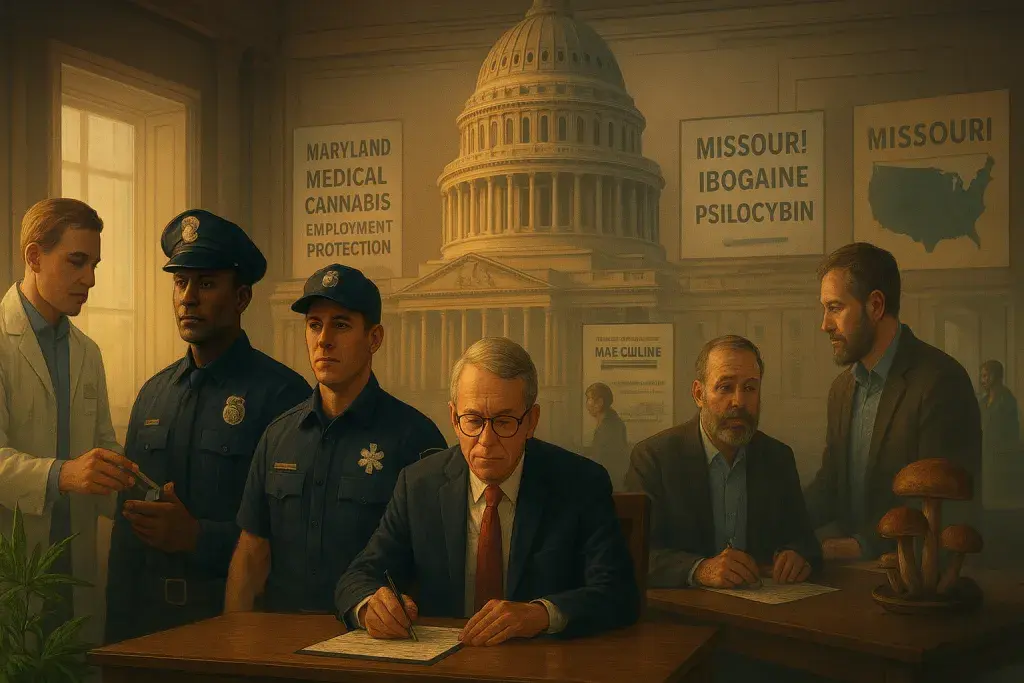
A growing number of state legislatures are moving this year to formally recognize that traditional counseling and medication alone may not be enough to address the psychological toll carried by firefighters, police officers, and emergency medical workers. From Ohio's new PTSD commission to Maryland's medical cannabis employment protections to Connecticut's expanded psilocybin research program, the policy shift is accelerating - and for licensed cannabis operators, parts of it carry direct business and compliance relevance.
Maryland's approach is the most immediately consequential for the regulated cannabis industry. A new law set to take effect in October prohibits employment discrimination against firefighters, EMTs, paramedics, and other rescue workers who are registered medical cannabis patients and test positive for cannabis metabolites - provided they are not impaired while on duty. The distinction matters: the law protects off-duty, lawful medical use, not on-duty consumption. For dispensaries serving medical cannabis patients in Maryland, this signals a modest but real expansion of the legitimate patient population in the workforce, with some protections now formalized at the state level. Operators in states watching Maryland's model may want to learn more about how adjacent regulated markets are building compliance frameworks around workforce and patient access policies, since those structural decisions often travel across state lines faster than the legislation itself.
Ohio took a different route. Republican Gov. Mike DeWine signed legislation establishing a Post-Traumatic Stress Injury Commission tasked with reviewing applications from eligible first responders seeking help covering treatment costs. The structure - a commission, not a direct benefit - means there will be an administrative layer between diagnosis and reimbursement, which is worth tracking as other states weigh similar models. It also raises a practical question for the broader behavioral health conversation: what qualifies as a covered treatment? As emerging therapies gain state-level recognition, the definitions written into commission guidelines will matter considerably.
Emerging Therapies Enter the Legislative Record
Connecticut expanded a Yale University pilot program studying psilocybin-assisted therapy this year, opening participation to any state resident 18 or older who meets clinical eligibility criteria set by Yale's institutional review board. Previously, enrollment was limited to veterans, retired first responders, and frontline health care workers. The expansion is meaningful precisely because it moves psilocybin research from a narrow, benefit-focused cohort into something closer to a general clinical trial framework - with eligibility still controlled, but the population no longer defined exclusively by occupational trauma.
Missouri lawmakers advanced a bill that would allow veterans and first responders in approved research studies to receive psilocybin and ibogaine under medical supervision for PTSD and related mental health conditions. The legislature adjourned in May before the bill reached the governor's desk. That outcome - promising movement that stalls before the finish line - is a familiar pattern in psychedelic policy, and it does not mean the effort is dead. Bills that fall short in one session frequently return the next with more co-sponsors and more political cover.
What This Means for Cannabis Operators and the Medical Market
The thing is, the cannabis industry has a genuine stake in how states frame first-responder mental health policy, even where the direct connection isn't obvious. Maryland's employment protection law is the clearest example: it validates medical cannabis as a legitimate treatment tool for a workforce population that has historically faced real professional risk for using it. That kind of statutory protection can shift patient behavior - meaning more first responders may seek medical cannabis registration who previously avoided it for fear of job consequences.
Jason Cerrano, a retired firefighter and paramedic with more than 20 years of experience in Missouri who now directs commercial research and development at IDEX Fire & Safety, described the cumulative nature of occupational trauma in plain terms: in the fire service and similar fields, repeated exposure to extreme events can normalize what should be recognized as serious psychological injury. That framing - cumulative exposure rather than single-incident trauma - is relevant to how treatment programs, including medical cannabis access, get designed and approved at the state level.
For multi-state operators, compliance teams, and medical cannabis program administrators, the takeaway isn't abstract. Employment protection laws, emerging research frameworks, and new state commissions are collectively redefining the regulatory environment around medical cannabis patients in the workforce. The operational implications - how dispensaries document medical recommendations, how patient registries interact with employer verification requests, how states define impairment versus use - are compliance questions that will sharpen as these laws move from enactment to enforcement.
The Broader Trend Worth Watching
What's striking here is the breadth. Ohio, Maryland, Connecticut, and Missouri took four meaningfully different approaches within a single legislative season. None of them are identical in structure, eligible population, treatment type, or enforcement mechanism. That divergence is typical of how cannabis and behavioral health policy develops across states - incrementally, inconsistently, and often faster than compliance professionals expect.
Dispensary operators in states where similar legislation is moving - or where first-responder advocacy groups are active - should be watching the fine print. Employment discrimination protections for medical cannabis patients, in particular, create new expectations around patient privacy, documentation, and the boundaries of on-duty impairment determinations. Those are not theoretical concerns. They are the kind of policy details that eventually show up in HR disputes, licensing reviews, and compliance audits.