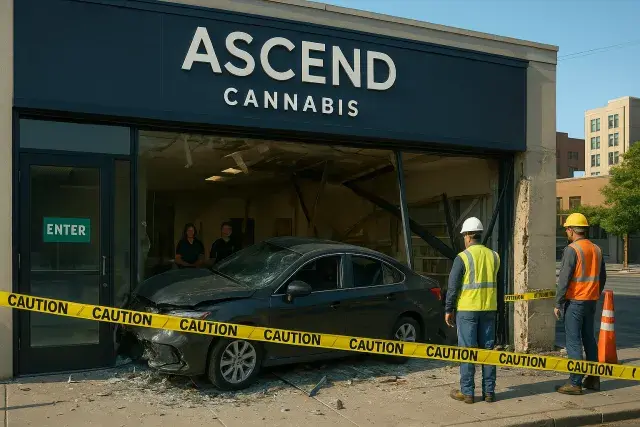
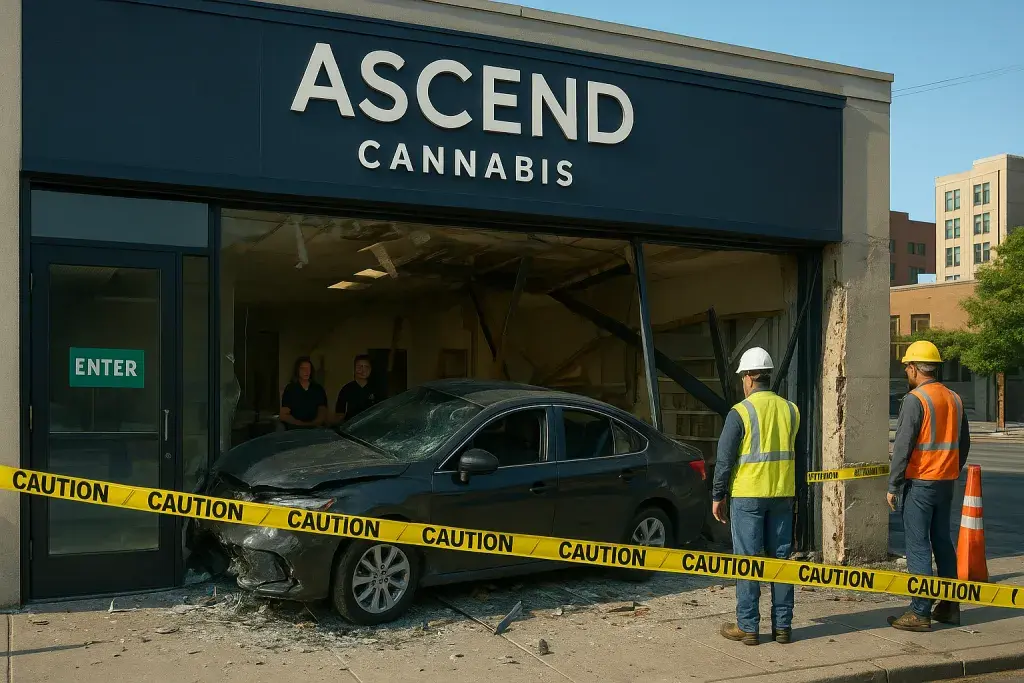
A vehicle collision left an Ascend Cannabis dispensary on South Yosemite Street in Denver with significant structural damage last week, after an elderly driver struck a glass portion of the building - reportedly due to brake failure. Two employees were inside at the time. Nobody was hurt. But the incident raises a set of operational and risk-management questions that licensed cannabis retailers, particularly single-location operators, rarely have formal playbooks for.
Operations Manager Benjamin Mahler confirmed that a load-bearing beam was taken out on the interior, requiring immediate structural assessment to keep the walls from collapsing. Crews worked to stabilize the building on-site. That kind of emergency response - contractors arriving fast, structural engineers or fire crews assessing load points - is not something most dispensary operators rehearse. It sits in the gap between a standard security protocol and a full business continuity plan. For context, operators running a cannabis retail platform for Maine or any other regulated state face similar physical and operational vulnerabilities; a cannabis retail location is a licensed facility with regulatory obligations that don't pause because the storefront is compromised.
Physical Risk Is an Underwritten Problem in Cannabis Retail
Cannabis dispensaries occupy a peculiar position in commercial real estate. They are often required by local zoning rules to maintain specific setbacks, security perimeters, and controlled-access entry points - but those same design requirements don't necessarily make a building more resilient against an unplanned vehicle impact. Glass storefronts, which are common in retail cannabis buildouts intended to project openness and legitimacy, are among the most vulnerable points of any commercial facade.
The thing is, cannabis retailers also carry a layer of compliance exposure that a standard retail shop doesn't. Active inventory on the floor, a functioning point-of-sale system, seed-to-sale tracking terminals, and on-site cash - all of which are present in most dispensaries - become immediate concerns the moment a building is structurally compromised. Regulators in most states require that licensed premises remain physically secure at all times. A wall that's been breached by a vehicle is, depending on the jurisdiction, a reportable incident. That means operators can't simply rope off the damage and keep selling.
Compliance Obligations Don't Stop at the Crash Scene
Licensed cannabis retailers are required to maintain the physical integrity of their licensed premises as a condition of holding an active license. What that means practically: if structural damage renders part of a dispensary inaccessible, unsecured, or non-compliant with state buildout requirements, the operator may have a reporting obligation to their state cannabis regulatory authority - and may need to temporarily suspend operations in affected areas until the space is brought back into compliance.
Inventory control is another pressure point. A compromised retail floor creates chain-of-custody questions. Were any products displaced, damaged, or exposed to public access during the incident? Most seed-to-sale tracking systems - METRC being the most widely deployed - require that any unaccounted-for product be logged and explained. Operators in this situation should document everything: the crash timeline, the condition of display cases and storage areas, any product that was moved or secured offsite, and the status of POS terminals and compliance hardware.
What Operators Should Have in Place Before an Incident Like This
Ascend Cannabis responded quickly - crews were on-site repairing damage in what appeared to be a timely manner. That's the right instinct. But it also points to something worth stating plainly: most cannabis dispensaries do not have a formal incident response protocol for physical building damage that sits alongside their security plans and compliance manuals.
A few things that belong in that protocol:
- A direct contact line to the state cannabis regulatory authority for after-hours incident reporting
- A documented procedure for securing and accounting for all on-floor inventory immediately after a physical breach
- A list of pre-vetted licensed contractors who can work on a cannabis-licensed premises - not every contractor is cleared or willing to work in a regulated facility
- Insurance documentation that specifically covers structural damage and business interruption for a cannabis retail operation - standard commercial property policies have historically excluded cannabis businesses, though coverage availability has improved
- A communication plan for staff, landlord, and regulator that doesn't require the operator to improvise under pressure
Nobody was injured at Ascend Cannabis. That's the outcome that matters most. But the structural and operational disruption this kind of incident creates - mid-day, with employees present, in an actively licensed and inspected retail environment - is exactly the kind of low-probability, high-impact event that cannabis operators need to prepare for with the same rigor they bring to inventory audits and compliance inspections.