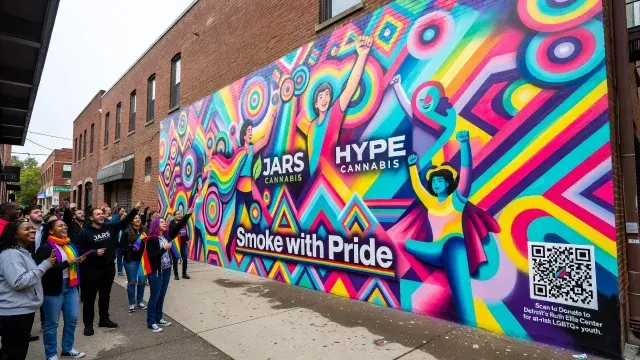
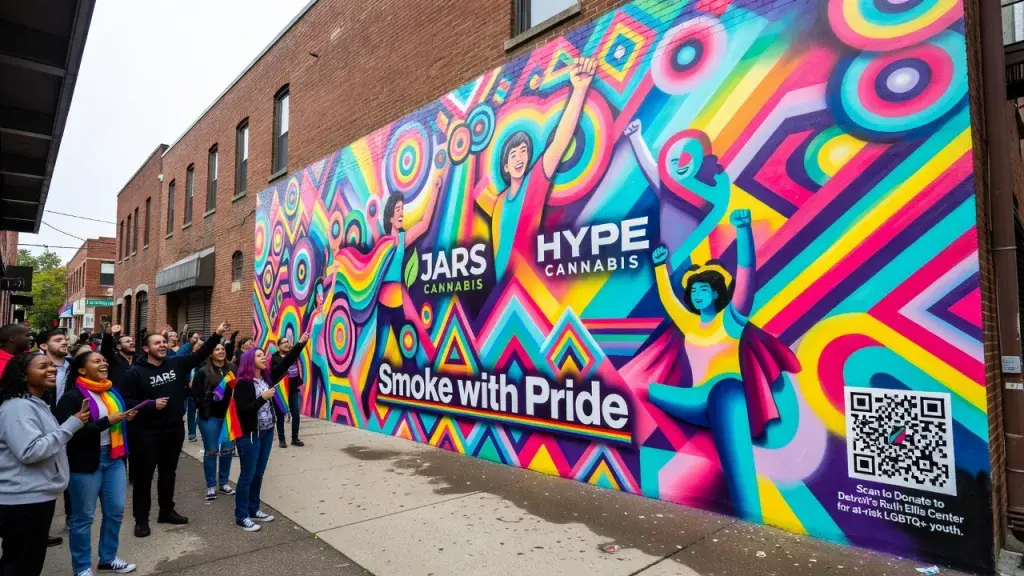
Two Michigan cannabis retailers just put a price tag on brand storytelling, and it's larger than most local advertising budgets. JARS Cannabis and HYPE Cannabis commissioned "Polychromatic Super You," a 40-by-25-foot mural by artist Joey Salamon, unveiled this week in the alley at 258 W. Nine Mile Rd. in downtown Ferndale. The piece anchors the companies' Smoke with Pride campaign, which channels a share of retail proceeds to Detroit's Ruth Ellis Center, a support organization for at-risk LGBTQ+ youth.
The mechanics matter here as much as the message. Ten percent of proceeds from HYPE products sold at JARS locations, plus 100 percent of proceeds from a co-branded Smoke with Pride kit, are earmarked for the center - a structured, trackable donation model that has to reconcile cleanly against sales data at the SKU level. That kind of granular attribution isn't trivial for a retailer; it requires point-of-sale infrastructure capable of isolating specific product lines, tagging promotional SKUs, and reporting donation totals without creating a compliance headache at tax time. Operators running lean back offices know this problem well, which is part of why platforms built around point of sale systems for dispensary minnesota and similar markets have leaned into configurable reporting tools rather than one-size-fits-all checkout software. point of sale systems for dispensary minnesota
Why Cause Marketing Is Harder Than It Looks in Cannabis
Charitable tie-ins are common in mainstream retail, but cannabis operators face constraints that liquor stores and pharmacies don't. Advertising restrictions vary by state and municipality, and many jurisdictions limit how dispensaries can promote donations or cross-brand campaigns, particularly where minors could be exposed to messaging. A mural in a public alley, rather than a storefront sign or social feed post, sidesteps some of that friction while still functioning as a marketing asset - a workaround worth noting for other operators weighing community-facing campaigns against local sign ordinances and cannabis-specific ad rules.
There's also the matter of proceeds tracking. Donating a percentage of sales sounds simple in a press release; in practice, it means finance teams need clean separation between promotional and standard-margin inventory, accurate batch-level sales data, and documentation that survives an audit. For a multi-location retailer, that's not a footnote - it's an operational build.
Public Art as Retail Real Estate Strategy
Murals and commissioned art have become a quiet tool in cannabis retail's broader push for legitimacy, particularly in markets like Michigan where dispensaries still work to normalize their presence in commercial corridors. A large-scale public artwork placed near a licensed retail cluster does double duty: it softens the visual footprint of adult-use retail in a walkable downtown, and it gives local officials and landlords a tangible community benefit to point to when cannabis tenants come up for lease renewals or zoning review.
The QR code embedded in the mural - linking visitors to donation pages and campaign information - is a small but telling detail. It shows retailers treating physical space as a data touchpoint, not just decoration, blurring the line between community investment and measurable marketing return. For compliance officers and landlords alike, that blend of civic gesture and tracked engagement is likely to show up more often as cannabis retailers compete for goodwill in the same neighborhoods where they still face zoning skepticism.