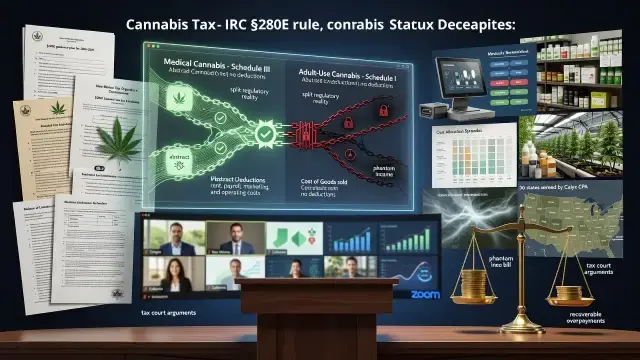

A panel of cannabis attorneys and a market strategy founder will walk operators, investors, and compliance teams through the regulatory forces set to reshape state cannabis markets heading into 2027. The live webinar, scheduled for November 19 at 12:00 p.m. PST / 3:00 p.m. EST, arrives at a moment when federal rescheduling, a pending crackdown on intoxicating hemp, and a fresh round of midterm election results are converging on state-licensed businesses all at once.
Why Rescheduling Still Matters, Even Unfinished
Marijuana rescheduling has been treated as a distant abstraction by some operators who've learned, fairly enough, not to hold their breath on federal cannabis reform. But the math here is concrete. If medical marijuana lands on Schedule III, state-licensed medical operators stand to see meaningful relief from the tax burden imposed by Section 280E, which currently blocks cannabis businesses from deducting ordinary business expenses because the plant remains federally illegal. That's not a minor accounting footnote - it's the difference between a sustainable margin and a strained one for many medical operators. The adult-use side of the rule, by contrast, remains stuck in litigation, which means recreational operators may be waiting considerably longer for the same tax relief, if it arrives at all.
The Hemp Loophole Is Closing
Intoxicating hemp products - the gummies, beverages, and vapes that exploited a gap in federal hemp law to sell THC-infused products outside state cannabis licensing systems - are headed for a federal shutdown. For state-licensed dispensaries that have spent years competing against unregulated hemp-derived products sold in gas stations and smoke shops without seed-to-sale tracking, lab testing, or compliant packaging requirements, this is a structural shift worth watching closely. It could meaningfully reduce competitive pressure on licensed retail, though the timeline and enforcement mechanics remain to be seen.
A Patchwork of State Outcomes
State-level cannabis policy did not move in one direction this cycle. Massachusetts voters rejected a measure to repeal their adult-use market outright, while Idaho voters preserved the right to pursue ballot-driven reform in the future. Pennsylvania and Wisconsin appear positioned to move toward adult-use legalization in 2027, and even traditionally conservative states - Texas, Iowa, North Carolina - show signs of policy movement. For multi-state operators and investors, this patchwork means due diligence can't rely on regional assumptions; each state's political and regulatory trajectory needs its own read.
DEA Supply Chain Rules Could Fracture Medical Markets
Here's the catch most headlines miss. DEA is requiring both expedited-window applicants and existing registrants to build closed supply chains that exclude other state-licensed operators. On paper, that sounds like a narrow compliance detail. In practice, though, it risks splitting state medical marijuana programs into two parallel, and potentially economically unsustainable, markets - one federally registered, one not. Wholesale pricing, inventory sourcing, and licensing strategy could all be affected depending on how this plays out, and operators who haven't modeled the downstream effects on their supply chain may be caught flat-footed.
The webinar is built for anyone with a stake in these outcomes - operators, investors, service providers, regulators - and includes a live Q&A session. Attendees can submit questions in advance through the registration link.