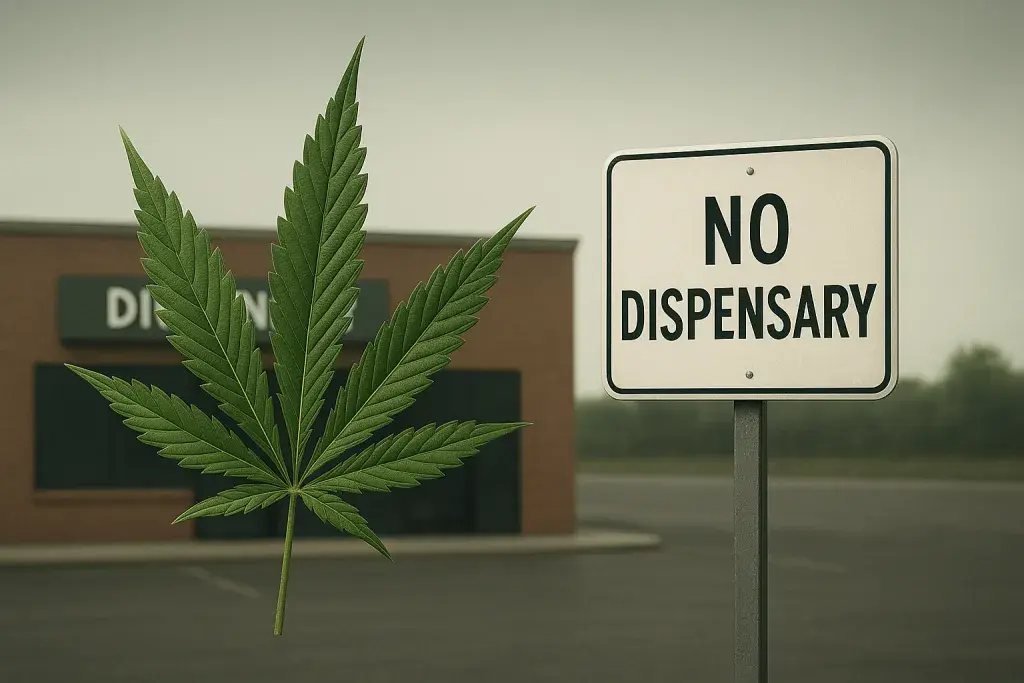
Nebraska voters approved limited medical cannabis in November 2024, and more than a year later, the state still has zero operational, licensed dispensaries. Recreational cannabis remains fully illegal. For Omaha residents wondering what's actually legal to buy right now, the honest answer is: hemp-derived products with minimal THC, full stop, and nothing else purchasable inside state lines.
The delay isn't unusual by regulated-market standards. Building a compliant retail system from scratch means standing up licensing procedures, seed-to-sale tracking requirements, packaging rules, and testing protocols before a single storefront opens its doors. The Nebraska Medical Cannabis Commission is still working through that buildout, and there's no reciprocity agreement recognizing Iowa or Missouri medical cards. For comparison, operators watching other markets mature have seen how long infrastructure decisions take to settle; retailers in New York, for instance, spent years sorting out licensing sequencing and point-of-sale requirements before storefronts opened at scale, with platforms like New York cannabis POS systems becoming part of the compliance backbone once dispensaries actually launched. Nebraska is earlier in that curve than most current medical states. New York cannabis POS
What's Actually Purchasable in Omaha Right Now
Hemp-derived products are legally available at smoke shops and specialty retailers throughout Omaha, and that's essentially the entire in-state legal market at this moment. Here's the catch: Nebraska doesn't currently require state testing specifically for hemp products, so cannabinoid content and disclosed potency can vary meaningfully between brands. Some products may carry undisclosed THC levels. That's a real consumer-safety gap, not a technicality, and it puts the burden on shoppers to scrutinize labeling and on retailers to source from reputable suppliers who provide accurate certificates of analysis.
- No state-licensed dispensary currently operates anywhere in Nebraska, including Omaha
- Qualifying patients have a legal possession allowance of up to five ounces, but no in-state retail source to obtain product
- Hemp-derived items remain the only cannabis-adjacent products purchasable at Nebraska retail
- No reciprocity exists for out-of-state medical cannabis cards
Crossing Into Iowa or Missouri Carries Real Exposure
Iowa's medical cannabidiol program is the closest option geographically, though it generally requires Iowa residency and an Iowa-issued card, which rules out most Omaha residents outright. Missouri's adult-use market, created under Amendment 3, is open to anyone 21 or older with valid ID, and one of the nearest dispensaries sits in Rock Port, roughly 70 to 75 miles from Omaha. Buying there is legal. Driving it back across the state line is not.
Federal law prohibits interstate cannabis transport, and Nebraska separately prohibits importing cannabis from another state, with no medical exception carved out for product bought in Iowa or Missouri. Law enforcement patrols along I-80 and I-29 near the border aren't hypothetical; a stop can trigger possession charges, vehicle search and seizure, and a criminal record depending on quantity and prior history. Simple possession isn't automatically treated as federal trafficking, but that distinction requires evidence of distribution intent, and it offers no real protection to someone simply crossing a state line with a personal amount.
Tribal Land and the Regulatory Gray Zone
Some tribal nations in Nebraska have explored cannabis programs under sovereign authority, but no confirmed, operational dispensary exists on tribal land today. Even if that changes, product purchased there becomes subject to Nebraska law the moment it leaves reservation boundaries. State and local police can patrol adjacent areas, and possession charges remain possible off tribal land regardless of where the product was obtained.
For dispensary operators, investors, and suppliers watching from outside Nebraska, the state is a useful case study in how long the gap between legalization and functioning retail infrastructure can stretch, and how much compliance ambiguity consumers absorb in the meantime. Tracking the Commission's licensing progress, legislative amendments, and tribal developments will matter more than any single announcement, since this remains, in every practical sense, a program still under construction.