
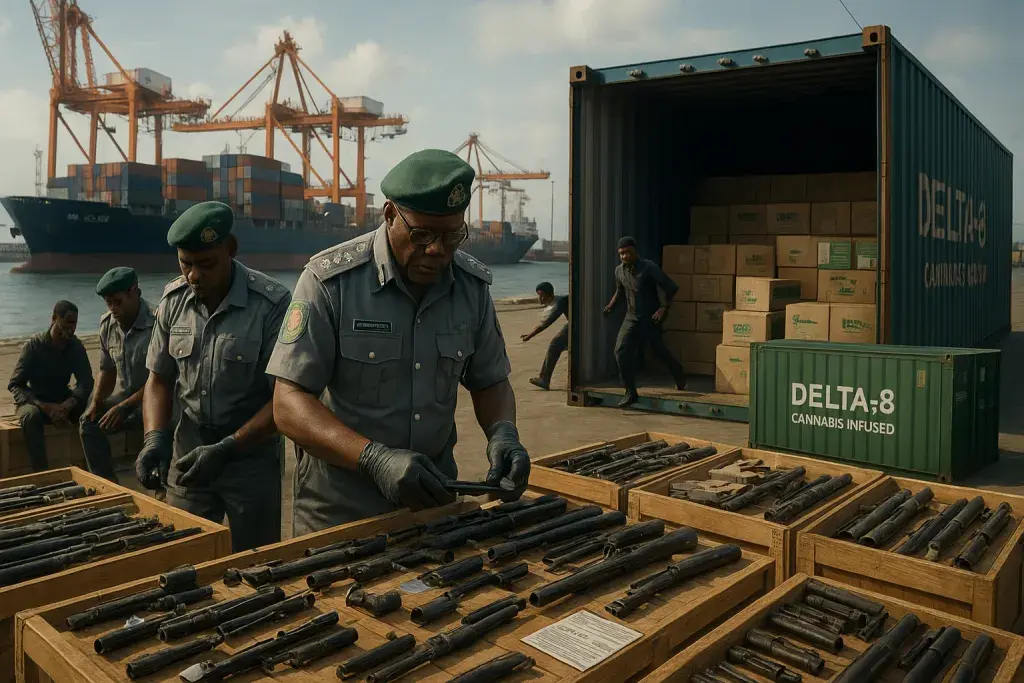
The Nigeria Customs Service (NCS) has disrupted what officials describe as a coordinated smuggling attempt at Tincan Island Port, intercepting a container loaded with disassembled pump-action rifle components and separately seizing cannabis-infused goods valued at more than ₦373.8 million. Comptroller General Adewale Adeniyi announced both seizures on Thursday, framing them as evidence of an intelligence-driven risk management system doing what it was built to do: flag anomalies before they clear the port.
For operators in regulated cannabis markets abroad, the episode reads differently than it might for a general audience - it's a reminder of how porous supply chains can become when documentation, inventory tracking and point-of-entry verification aren't tightly enforced. In legal U.S. markets, that same discipline shows up as seed-to-sale tracking and compliance logging built into daily retail operations; dispensaries in Michigan, for instance, rely on systems like Metrc-compliant POS for Michigan to keep every SKU traceable from cultivator to counter, precisely the kind of chain-of-custody visibility that informal or illicit channels lack entirely.
What the Seizure Actually Involved
The rifle parts arrived aboard MV VELIKA on 8 July 2026 and sat undetected until Customs' risk profiling flagged the container for enhanced screening. Investigators found knocked-down components preliminarily identified as JoJeff pump-action rifles hidden inside crates - over 140 units' worth, according to the CGC. Two suspects have been arrested; a third remains at large. Separately, two 40-foot containers carrying used vehicles, generators and batteries were found to be concealing Delta-8 cannabis-infused pre-roll cookies, gummies and cookie products, totaling 307 cartons across three product categories.
Why Concealment Tactics Matter to Legitimate Trade
Here's the catch for anyone in licensed cannabis commerce watching this from a distance: smuggling operations that hide contraband inside legitimate-looking freight - vehicles, appliances, batteries - erode public and regulatory trust in cross-border commerce generally, including cannabis-adjacent goods moving through legal channels. Nigeria does not maintain a regulated adult-use or medical cannabis retail market comparable to U.S. states, so any cannabis-infused product entering the country arrives through unauthorized routes by default. That's a meaningfully different risk profile than a dispensary managing wholesale menus, lab-tested batches and compliant packaging under a state's regulatory framework. No COA, no verified potency labeling, no age-gating at point of sale - just concealed cargo moving through a port on falsified manifests.
The Election-Season Pressure Point
Adeniyi's warning about the coming election cycle is worth sitting with. He said criminal networks typically intensify efforts to exploit ports and borders during politically sensitive periods, and that Customs will "redouble" enforcement accordingly. In practice, though, this kind of seasonal enforcement surge tends to reveal existing gaps rather than create new capacity overnight - intelligence systems, sister-agency coordination and internal integrity checks either scale or they don't. The CGC's pointed comment about not harboring internal accomplices signals an awareness that risk-based screening only works if it isn't quietly circumvented from within.
The Broader Compliance Lesson
For B2B stakeholders anywhere along a regulated supply chain - cannabis or otherwise - the takeaway isn't really about Nigeria's ports specifically. It's about what happens when tracking, documentation and verification break down at any link. Licensed markets built seed-to-sale infrastructure precisely because unregulated movement of cannabis products creates consumer-safety blind spots: no lab testing, no dosage transparency, no accountability if something goes wrong. That gap is exactly what this seizure illustrates, just on a different continent and under a different legal framework.