Purchasing decisions in commercial print still come down to one line item more often than not: cost. Kodak argues that's a mistake, and not just a moral one - it's an operational blind spot that can quietly inflate a print service provider's expenses and its environmental footprint at the same time.
The Problem With Price-First Thinking
Rising utility bills and tight margins make upfront cost an easy filter to apply. Fair enough - nobody budgets for infinity. But a narrow focus on invoice price can obscure what a product actually costs once it's running through a press day after day. John Diggory, Kodak's director of worldwide health, safety and environment, points to the cumulative effect of routine operational choices as the real driver of environmental impact. Older equipment burns more energy than it needs to. Lower-quality consumables generate more waste and more maintenance calls. None of that shows up on the original purchase order, yet it shapes the real cost of ownership over the life of the equipment.
Reliability as a Sustainability Lever
Here's the catch: sustainability and uptime are not separate conversations. Fewer equipment failures mean fewer reprints, less wasted substrate, and less unplanned downtime - all of which reduce both cost and resource consumption in one motion. That reliability depends on more than the hardware itself. Maintenance programs, technical support responsiveness, and product longevity all factor into how much a print operation actually consumes over time, which is why vendor selection matters as much as equipment specification.
Process-Free Plates as a Case Study
Kodak's SONORA process-free plate line removes water, chemistry, and the associated energy draw from the plate-making stage entirely. That's a structural change, not an efficiency tweak - the resource demand is designed out of the workflow rather than offset later through cleanup or compensation measures. Diggory frames it plainly: eliminating those inputs removes the demand from the system instead of trying to manage it after the fact.
What Total Cost of Ownership Actually Includes
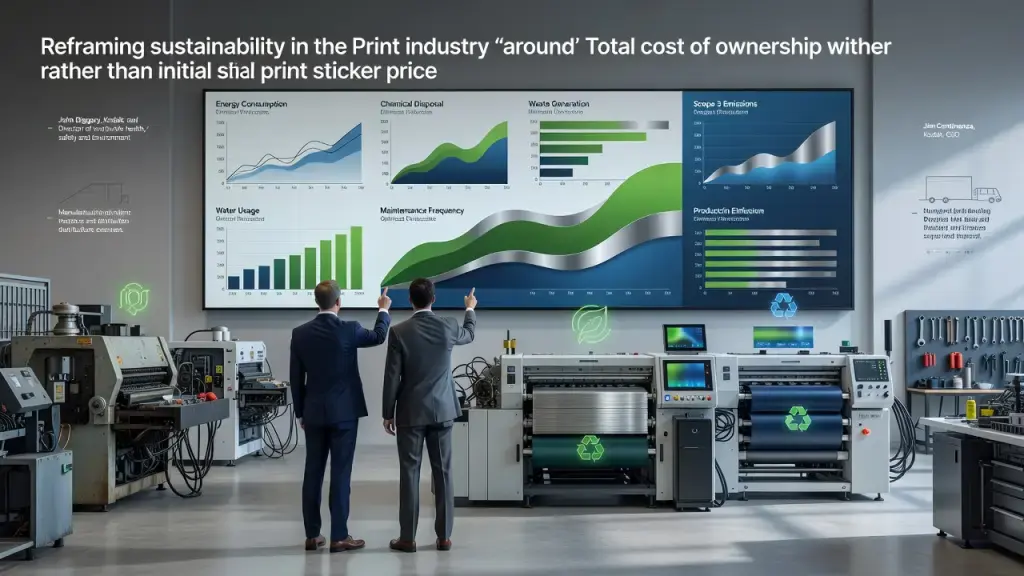
Evaluating a product on total cost of ownership means accounting for more than the invoice. Relevant factors include:
- Energy consumption during operation
- Water usage in processing stages
- Chemical requirements and disposal
- Waste generation and rework rates
- Maintenance frequency and product longevity
- Production efficiency and failure rates
The calculation extends past the print shop floor, too. Scope 3 emissions - generated through manufacturing, transport, and distribution - often make up a significant share of an organization's overall footprint, even though they're invisible on a shop's own utility bill.
Sustainability as Ongoing Strategy
Jim Continenza, Kodak's CEO, describes sustainability as something that has to run in two directions at once: understanding how a company's own operations affect the wider environment, and understanding how regulatory and environmental shifts affect customers. That dual view, he says, now informs product development and investment decisions across the business. The larger point holds regardless of which vendor is making it: when total cost of ownership becomes the measuring stick, the question shifts from what's cheapest today to what actually holds up over the long run.